About Me
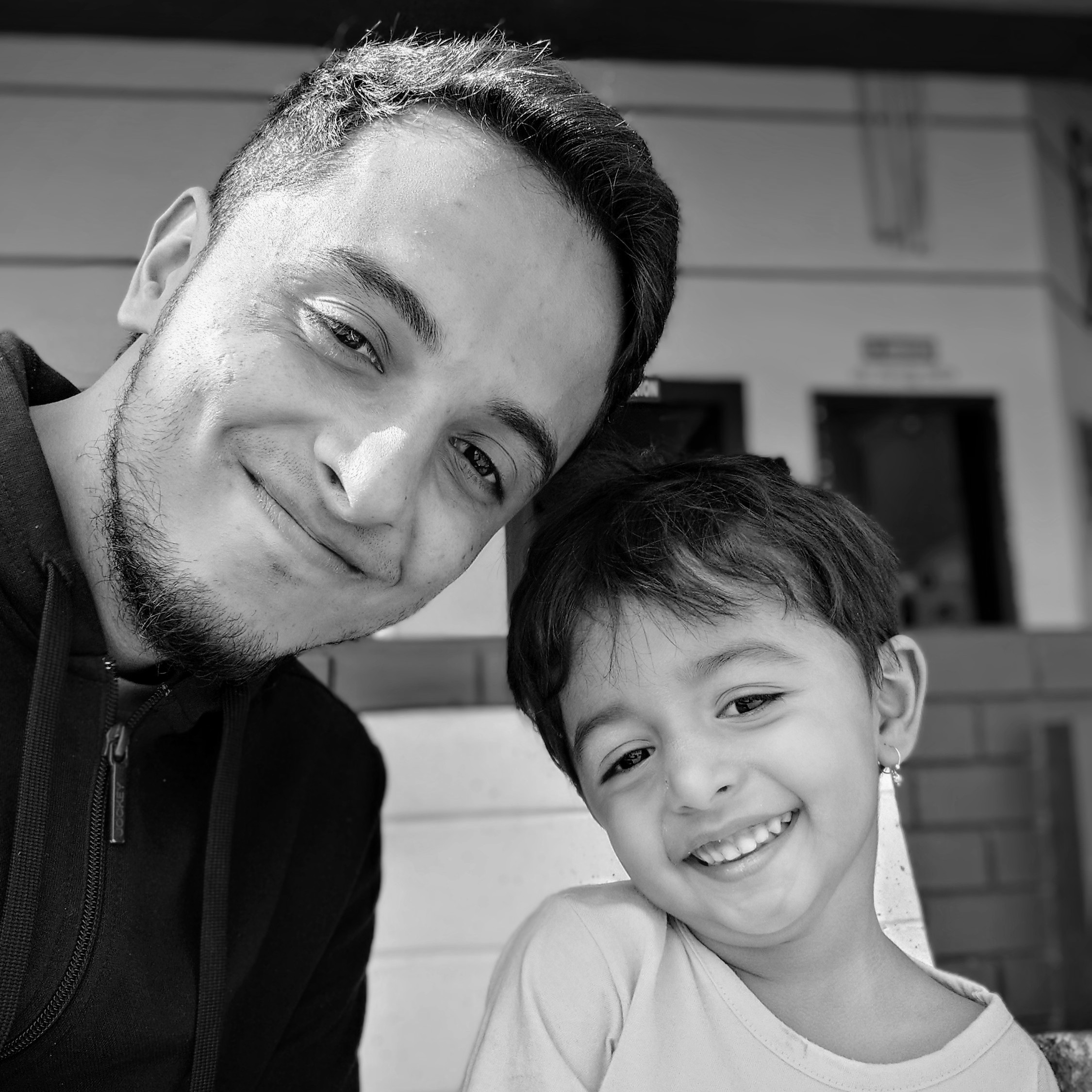
Maker at heart I’m often described as an engineer or a hobbyist with strong technical skills , but at heart I’ve always been a maker, long before I knew what engineering even was.
As a child, I loved art, crafts and drawing. I spent countless hours building cars, planes, satellites, sliding phones, and even crude robots out of cardboard, trying to replicate real-world shapes as accurately as I could. I wasn’t following instructions, I was visualizing how things should look and fit together, then figuring out how to make them.
That instinct never really left.
Curiosity before curriculum Alongside making things, I was deeply fascinated by technology and science. I was the kid who grew up watching Discovery Channel, National Geographic, and science-fiction movies and cartoons; constantly curious about electronic gadgets, futuristic devices, and robots.
That curiosity naturally led me to pursue Computer Science. I genuinely enjoyed almost every subject, but I never limited my learning to the curriculum or to what was taught in class. I studied most topics on my own by reading books, experimenting, and breaking things until I understood them.
Learning by building Once I learned to program, I deliberately invested time in areas that weren’t part of the syllabus. I bought an Arduino, worked with servos, and explored electronics just to get hands-on exposure beyond software.
Even before completing my bachelor’s degree, I was able to build websites and Android apps independently (without perfect software practices at the time, of course). This naturally led me into freelancing: fixing bugs, enhancing features, and building small applications for real users.
From experiments to real systems I carried the same self-driven approach into my master’s program. My professors recognized my curiosity and effort and were incredibly supportive. They encouraged me, invited me to take sessions for senior students, and students from other departments often approached me for help with their projects. I remain deeply grateful for that trust and mentorship. Shout out to Professor Dr. Shivanand Gornale, Dr. Parshuram Bannigidad, Dr. Arun Kumar, Dr. Mallamma Reddy, Dr. Namita Portraj, etc. :)
During my final semester, which focused on internships, I began exploring opportunities even before the term officially started. I was fortunate to connect with people who recognized my work and offered me meaningful opportunities. What helped me stand out was an Android file-sharing app I had built and open-sourced on GitHub.
The team I joined worked on ambitious products: a highly advanced dialer app with non-standard UI, rich animations, and features like co-browsing, shopping, music playback, and WebRTC-based video calls. Over time, it evolved into a reaction platform for YouTube videos and later into a content-sharing app that rewarded users for engagement.
Working on such systems gave me deep exposure to complex, real-world problems. I worked closely with senior engineers as well as independently, building technically challenging, non-standard interactive UI components. Over time, I naturally became the go-to person for complex UI and graphics-heavy interactions.
From pixels to physical systems Later in my career, my interest in building physical things resurfaced. I invested in a 3D printer and began thinking more seriously about the connection between software and the physical world.
If math and logic can move pixels on a screen, why can’t they move physical systems the same way?
That question led me to build a simple 2-DOF robotic arm. Experiencing something move physically (driven by code and math) was deeply satisfying. From there, I expanded my electronics knowledge through textbooks and hands-on experimentation, eventually moving into bare-metal microcontroller programming using AVR.
Foundations and direction Fundamentals matters more to me and I enjoy learning things from the ground up, so that when I’m building something simple or complex, I can reason through problems and know what's possible and what's not; rather than working blindly. Whether it’s software, UI systems, or physical machines, I’m most motivated when I can understand why something works, not just how.
At the core, I’m someone who enjoys understanding systems deeply and building things — whether they live on a screen or move in the real world.
Today, I’m actively learning mathematics (calculus, linear algebra), embedded systems and Robotics.
I’m aiming to transition into more research-driven roles in robotics and system engineering — places where creativity meets engineering rigor. I’m particularly passionate about real-time control systems, mechanical behavior, embedded optimization, and interactive graphics.